
These TRCN questions on Numeracy are all from its sub-topics in the TRCN EXAM SYLLABUS.
We have also covered each of the Numeracy sub-topic with detailed explanation in our TRCN notes.
Why Numeracy isn’t just for Math teachers
TRCN sees Numeracy as a general teaching competency, not a subject specialization.
This is because every teacher handles numbers in some form regardless of what they were trained to teach.
- An English teacher still calculates grades and tracks attendance percentages.
- A Social Studies teacher reads statistics in a textbook and has to explain them.
- Even a Fine Arts teacher measures proportions and ratios when teaching design.
TRCN exam isn’t testing if you can teach Maths, it tests your ability to function as a professional in a system that runs on numbers.
This is why TRCN Numeracy is for every candidate sitting the exam, not just those who studied Maths.
What Numeracy questions to expect
TRCN questions on Numeracy stay at a foundational level.
Remember TRCN is not trying to certify Math teachers through this section.
It just wants to confirm that you have the basic number confidence to avoid embarrassing errors in front of a classroom, no matter what you teach.
An indirect skill this section tests is your reading comprehension inside math questions.
Words like “product,” “difference,” “sum” and “quotient” are operational instructions disguised as English.
And TRCN uses them to check if you can translate language into the correct calculation.
Because a History teacher who misinterprets a percentage in class or an English teacher who fails a simple fraction while explaining a word problem in a passage weakens their authority.
But passing this section isn’t proof of Math mastery.
It just proves that you can be trusted with the basic arithmetic that every subject indirectly depends on.
Two mistakes that cost the most marks
The first is misapplying BODMAS.
Especially forgetting that Order (powers and roots) comes before Multiplication and Division.
Or skipping brackets without solving what’s in them first.
And the second is misreading negative numbers.
Particularly the idea that the bigger the negative number, the smaller the value.
Many candidates strong with positive numbers sometimes mix this up under pressure.
Both mistakes are avoidable with slow, deliberate reading, not extra math knowledge.
Now let’s practice.
TRCN Numeracy questions
Attempt the questions before checking the correct answer and explanation.
1. Learners compute 120 divided by 5 plus 3 multiplied by 7. What is the correct result?
- 57
- 51
- 45
- 39
SEE ANSWER ✅
According to BODMAS, division first.
Then multiplication.
Before addition.
2. Evaluate: –6 + 14
- 20
- -20
- 8
- -8
SEE ANSWER ✅
Minus (-) is what you owe. Plus (+) is what you have. So if you have (14) and you pay off the (6) that you owe, how much do you have left?
3. What is the product of 28 and 5
- 110
- 120
- 130
- 140
SEE ANSWER ✅
“Product” means multiplication.
4. Find the difference of 600 and 248
- 342
- 350
- 352
- 360
SEE ANSWER ✅
“Difference” means subtraction.
5. If n = 3² × 5, what is n?
- 30
- 45
- 75
- 90
SEE ANSWER ✅
- In BODMAS, order (O) before multiplication (M).
- Order: 3² means (3 × 3) = 9.
- Now, 9 × 5 is equal to ?
6. Rewrite 8.206 with the 2 in the hundredth place.
- 8.260
- 8.026
- 8.206
- 8.602
SEE ANSWER ✅
The first digit after a decimal point is the Tenths place, the second is the Hundredths, third is Thousandths and so on.
7. Simplify: (7² − 5²) ÷ 2
- 9
- 11
- 12
- 13
SEE ANSWER ✅
In BODMAS, brackets (B) first. And in the brackets, solve the order (O) before subtraction (S)
- 7² means 7 × 7 = (49)
- 5² means 5 × 5 = (25)
- (49 − 25) = 24
After solving the brackets…
8. Solve: 49 ÷ 7 × 3
- 18
- 21
- 24
- 15
SEE ANSWER ✅
According to BODMAS, divide first before multiplying.
9. A teacher asks which of these fractions is the largest.
- 5 over 12
- 4 over 9
- 3 over 7
- 7 over 18
SEE ANSWER ✅
- How it looks like:
- Find the LCM of the denominators.
LCM of 12, 9, 7 and 18 = (252)
- Multiply each numerator by the same number that turns its denominator to 252.
- Since they now all have the same denominator, the one with the biggest numerator is the largest.
10. Which value is the smallest?
- –18
- 0
- –4
- 7
SEE ANSWER ✅
Numbers with minus (-) are below zero. And the larger the number with minus, the smaller it is.
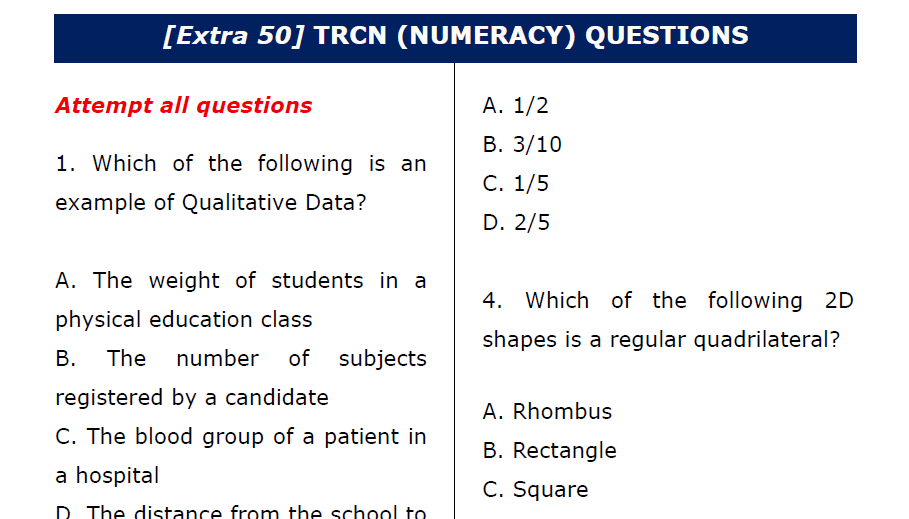
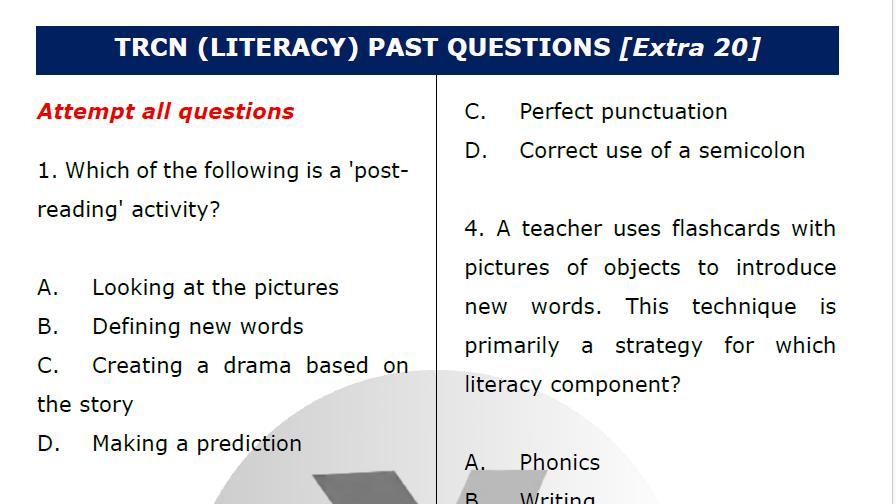
Download “tougher” TRCN questions on Numeracy PDF
Get e-Notes and CBT
Did you fail many of the TRCN Numeracy questions above?
Get Numeracy e-Notes and also practice more questions on all the (5) TRCN topics in CBT format?



Leave a Reply