
These TRCN questions on Pedagogy are all from its sub-topics in the TRCN EXAM SYLLABUS.
We have also covered each of the Pedagogy sub-topic with detailed explanation in our TRCN notes.
Areas TRCN Pedagogy questions are drawn from
TRCN questions on Pedagogy are asked from 6 sub-topics in the syllabus and each one has its own question style.
1. Foundations of Learning tests your knowledge of theory names and their real classroom application.
For example, recognising that a teacher praising desired behaviour is applying Bandura’s Social Learning Theory.
Or that a task just beyond a learner’s independent ability sits in Vygotsky’s Zone of Proximal Development.
2-3. Instructional Planning and Teaching Methodologies test if you can match a teaching strategy to a specific classroom situation, like flexible skill-based grouping.
4. Classroom Management stresses practical routines, multi-grade teaching challenges and how rules are introduced and enforced.
5. Differentiated Instruction tests whether you can adjust tasks to different ability levels within one class.
6. Assessment and Evaluation covers the difference between formative and summative tools with marking practices like horizontal marking across scripts.
| Sub-topic | What it tests |
|---|---|
| Foundations of Learning | Applying named theories to real scenarios. |
| Instructional Planning | Matching lesson strategy to learner needs and objectives. |
| Teaching Methodologies | Choosing the right method for a given class situation. |
| Classroom Management | Routines, rules and handling multi-grade classrooms. |
| Differentiated Instruction | Adjusting tasks for different ability levels in one class. |
| Assessment and Evaluation | Formative vs summative tools and fair marking practices. |
Multi-grade and marking questions fails candidates the most
Two areas worth extra attention are multi-grade classroom management and marking practices because Nigerian teacher training doesn’t always cover them.
A multi-grade classroom is one where a single teacher handles learners from different grade levels at once.
Most common in rural and under-staffed schools.
TRCN tests your ability to plan and supervise across this gap rather than just defining the term.
Horizontal marking too, which means grading one question across every script before moving to the next.
This is the standard for high-stakes exams because it keeps grading criteria consistent.
But many have only marked the opposite way (script by script) and so, they get confused by this question style.
If a theorist like Bandura’s or Vygotsky’s is unfamiliar, study our e-NOTE ON FOUNDATIONS OF LEARNING before taking more Pedagogy questions.
Because most tricky scenario questions build on those two theorists.
TRCN Pedagogy questions
Attempt the questions before checking the correct answer and explanation.
1. In social learning theory, learners acquire new behaviour mainly by _____
- reading silently without thinking
- observing and imitating models
- sleeping in class
- forgetting past experiences
SEE ANSWER ✅
Social Learning Theorist (Albert Bandura) suggests that people learn observation, imitation and modeling.
2. A teacher groups learners by skill level rather than grade to practise reading. This flexible grouping mainly aims to _____
- fit tasks to learners’ abilities
- ignore grade differences
- separate friends
- prepare only for examinations
SEE ANSWER ✅
Students in the same grade may have very different reading levels. Grouping helps the teacher manage the task and provide relevant support for each level.
3. Vygotsky’s Zone of Proximal Development refers to tasks that a learner can _____
- do only at home
- do alone without help
- do with little guidance
- not do even with support
SEE ANSWER ✅
Zone of Proximal Development (ZPD) is that middle (support) gap between what a learner can do independently and what they can’t do at all.
4. Daily classroom routines help learners to _____
- avoid responsibility
- move smoothly between tasks
- depend only on the prefect
- guess what to do each period
SEE ANSWER ✅
Daily classroom routines are consistent procedures a teacher establishes for repeated tasks (like entering the room, submitting assignments or transitioning between subjects).
5. A balanced assessment plan for a term should include _____
- daily high-stakes exams
- oral questions only
- quizzes, assignments and a final test
- one final exam only
SEE ANSWER ✅
“Balanced” means a mix of evaluation types (Formative: quiz, assignment, project and Summative: final test).
6. Social reconstructionist theories expect schools to _____
- maintain society exactly as it is
- avoid community issues
- focus only on examinations
- prepare learners to solve social problems
SEE ANSWER ✅
Social Reconstructionism is a philosophy of education that views schools as a powerful tool for social change.
7. Which behaviour is most helpful in managing a multi-grade classroom?
- Standing in one place
- Talking only to older learners
- Frequent movement to monitor groups
- Ignoring some groups
SEE ANSWER ✅
“Active supervision” is critical in a multi-grade classroom (where one teacher teaches students of different grade levels in the same room).
8. When introducing class rules, the teacher should _____
- announce them only during exams
- discuss them with learners and display them visibly
- keep them in a private file
- read once and remove
SEE ANSWER ✅
When learners help create the rules, they are more likely to follow them and a visible display acts as a constant, silent reminder.
9. A common challenge in multigrade teaching is _____
- too many teachers
- excess space
- lack of learners
- planning for different ages simultaneously
SEE ANSWER ✅
Multi-grade teaching is when one teacher is responsible for students of different grade levels in the same classroom. The challenge is often finding ways to teach each level without leaving the other idle or overwhelmed.
10. Marking one question across all scripts before moving to the next mainly _____
- reduces marking time
- maintains consistent standards
- removes need for a marking scheme
- makes scores unreliable
SEE ANSWER ✅
This is called horizontal marking and is considered best in professional or high-stakes exam because it ensures reliability and reduces bias.
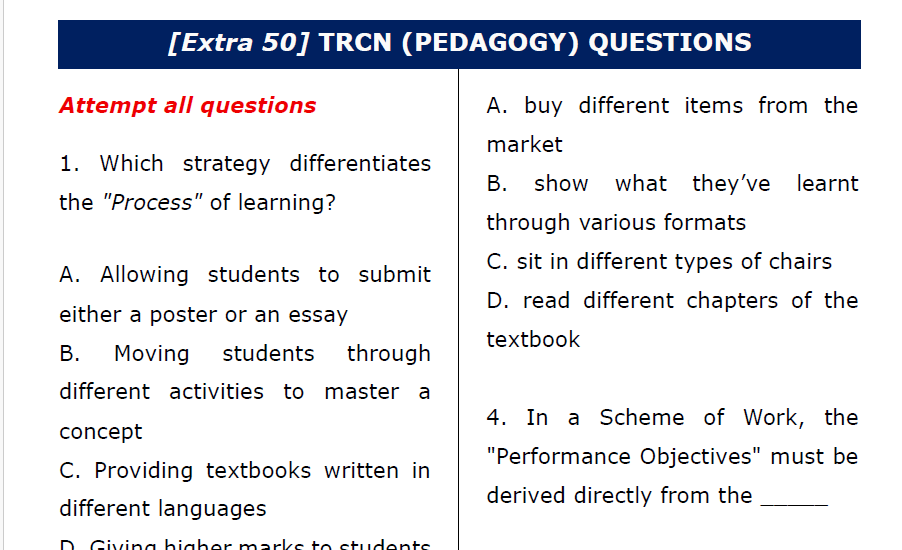
Download “tougher” TRCN questions on Pedagogy PDF
Get e-Notes and CBT
Did you fail many of the TRCN Pedagogy questions above?
Get Pedagogy e-Notes and practice more questions on all the (5) TRCN topics in CBT format?



Leave a Reply