
These TRCN questions on Literacy are all from its sub-topics in the TRCN EXAM SYLLABUS.
We have also covered each of the Safeguarding sub-topic with detailed explanation in our TRCN notes.
What Literacy covers beyond Reading Comprehension
A good number of TRCN Literacy questions test whether you understand the mechanics of teaching English itself.
From the stages of writing to grammar rules to how learners decode words.
A teacher who reads fluently may still be unable to explain why “definitely” is spelt that way or why question tags flip to negative.
TRCN tests that instructional knowledge using scenario questions rather than straight grammar drills.
| Skill area | What TRCN tests |
|---|---|
| Writing Process | Ordering the stages: pre-writing, drafting, editing, publishing. |
| Grammar | Applying rules like question tags and subject-verb agreement. |
| Spelling | Recognising correct forms, often tied to root words and affixes. |
| Phonics and Phonemic Awareness | Distinguishing letter-sound relationships from individual sound recognition. |
| Reading Fluency | Choosing activities that build expression, pacing and confidence. |
| Vocabulary Instruction | Using tools like word webs and context clues to teach word meaning. |
Why mixed-age classroom questions appear so often
A pattern worth noticing in TRCN Literacy questions is the both “primary and secondary” scenario.
This reflects real classroom reality in Nigerian schools.
Especially in under-staffed or multi-grade settings where one teacher handle learners at different literacy stages at once.
And Reader’s Theatre keeps appearing as the correct answer in these scenarios.
Because it lets weaker readers participate through repetition while stronger readers handle more complex expression, all within the same activity.
Scaffolding follows the same logic.
Temporary support that’s slowly withdrawn as the learner gains independence.
This is a concept TRCN tests far more often in application than definition.
If the phonics questions felt shaky, review them side by side rather than as one blended idea before your next attempt.
TRCN Literacy questions
Attempt the questions before checking the correct answer and explanation.
1. Which step comes before drafting?
- Editing
- Pre-writing
- Publishing
- Reviewing
SEE ANSWER ✅
Pre-writing is the first stage where you gather thoughts, data and outline structure before the main writing then you review, edit and publish.
2. Which is the correct question tag for ‘You will come, ______’?
- will you?
- won’t you?
- are you?
- aren’t you?
SEE ANSWER ✅
The statement is positive with an auxiliary verb (will), so the tag must be the negative form of that same auxiliary verb.
3. Which sentence is grammatically correct?
- He go to school everyday.
- He goes to school every day.
- He going to school every day.
- He gone to school every day.
SEE ANSWER ✅
When the sentence is simple present tense and the subject is He, She, or It, you must add -s or -es to the base verb.
4. Choose the correct spelling.
- definately
- definitely
- definitly
- definate
SEE ANSWER ✅
“definitely” comes from the root word ‘finite’ (fixed or limited). When you add the prefix de- and the suffix -ly, the “i” remains.
5. A teacher is introducing the concept of ‘Alphabetic Principle’ to a mixed-age class. Which activity is most appropriate for both primary and early secondary students?
- Decoding multisyllabic words.
- Matching letters to their most common sounds.
- Analyzing the etymology of words.
- Writing a formal essay.
SEE ANSWER ✅
The Alphabetic Principle explains that there is a relationship between written letters (graphemes) and spoken sounds (phonemes).
6. Which reading fluency technique is suitable for improving expression and pacing across both primary and secondary school levels?
- Silent reading
- Reader’s Theatre
- Individual timed reading
- Reading a new, complex text
SEE ANSWER ✅
Reader’s Theatre is an oral reading activity where students read scripts from literature. It is effective because while the secondary students benefit from the complex text, the primary enjoy the “play” and both follow the script pacing, using their voices for different expressions.
7. Which strategy supports struggling learners using guided help?
- Scaffolding
- Rote learning
- Guessing
- Transcribing
SEE ANSWER ✅
Scaffolding is a teaching method where a teacher provides the learner with temporary support which is gradually removed as the learner becomes more independent.
8. A teacher is using a ‘word family’ chart (e.g., cat, bat, hat). This is a strategy for teaching ______
- reading fluency
- phonics and phonemic awareness
- grammar
- oral communication
SEE ANSWER ✅
- Using word families helps learners recognize patterns in language.
- Phonics connect sounds to letters. (e.g. Seeing that -at sounds the same in cat, bat, hat).
- Phonemic awareness teaches students to hear the individual sounds in a word. (e.g. By changing only the first letter in cat, bat, hat).
9. A teacher uses a ‘word web’ to show how a new word is related to other known words. This is a strategy for ______
- Reading fluency
- Vocabulary instruction
- Grammar correction
- Spelling test
SEE ANSWER ✅
Word web is a visual tool used to help students understand of a word’s meaning better. So, instead of just memorizing a definition, they connect the new word to its synonyms, antonyms and usage sample.
10. Which strategy uses nearby words to infer meaning?
- Context clues
- Rhyming
- Copying
- Memorising
SEE ANSWER ✅
Context clues are hints in a sentence, paragraph or passage used to understand and “infer” (make an educated guess of) the meaning of a new or unfamiliar word based on the other words surrounding it.
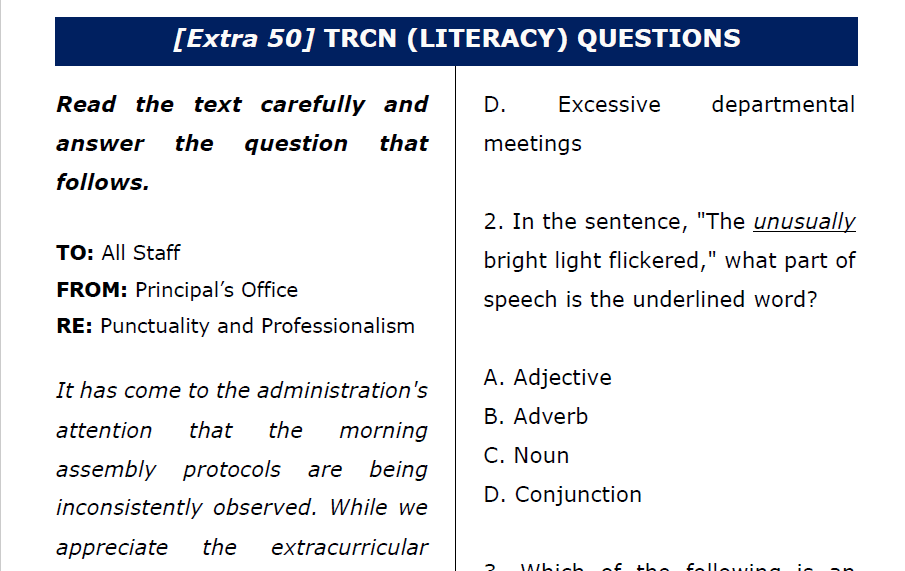
Download “tougher” TRCN questions on Literacy PDF
Get e-Notes and CBT
Did you fail many of the TRCN Literacy questions above?
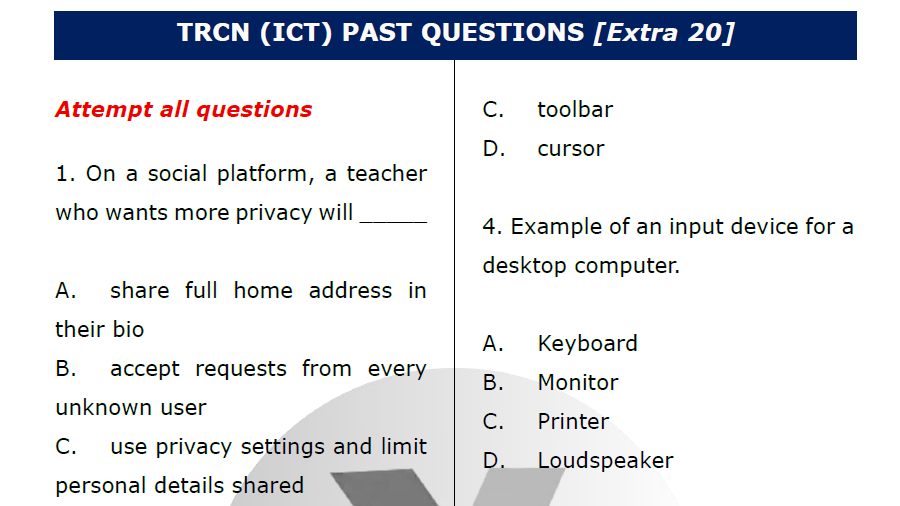
Get Literacy e-Notes and also practice more questions on all the (5) TRCN topics in CBT format?



Leave a Reply