
These TRCN questions on Safeguarding are all from its sub-topics in the TRCN EXAM SYLLABUS.
We’ve also covered each of the Safeguarding sub-topic with detailed explanation in our TRCN e-Notes.
Where are TRCN Safeguarding questions from?
TRCN questions on Safeguarding are built from four sub-topics.
1. Foundational Principles and Policies covers concepts like “duty bearer” and alignment with Nigeria’s National Policy on Safety, Security and Violence-Free Schools.
2. Recognising Signs of Abuse and Reporting Mechanisms tests if you can spot behavioural red flags like a learner suddenly avoiding a specific area of the school.
3. Prevention and Awareness focuses on proactive steps, like improving poorly lit areas or setting classroom norms around kindness.
4. Professional Ethics and Conduct covers how a teacher is expected to behave and respond once a concern is raised.
| Sub-topic | What it tests |
|---|---|
| Foundational Principles and Policies | Core terms like “duty bearer” and alignment with national safeguarding policy. |
| Recognising Signs of Abuse and Reporting Mechanisms | Spotting behavioural red flags and documenting concerns. |
| Prevention and Awareness | Proactive steps towards risk reduction. |
| Professional Ethics and Conduct | Expected teacher behaviour once a safeguarding concern is raised. |
Why Duty Bearer and Grooming indicators confuse candidates
Two terms in the sample questions are worth studying more than the rest.
“Duty bearer” means anyone with a formal or professional obligation to protect children.
This includes teachers and school leadership but excludes an older learner or a random community member, even though both might care about a child’s wellbeing.
Next is grooming, which TRCN frames as a process where gifts or favours are used to build a sense of obligation gradually isolating the child from those who can see something wrong.
Looking beyond the gift itself to understand the intention is what the exam really checks for.
Documentation also deserves a second look.
Recording a child’s exact words (not a summary) holds up better if the case moves to a formal investigation.
TRCN Safeguarding questions
Attempt the questions before checking the correct answer and explanation.
1. Which statement best describes “duty bearer” in child safeguarding within Nigerian schools?
- Those with responsibility to uphold children’s rights
- Any adult in the wider community
- Only police and social welfare officers
- Any older learner in the class
SEE ANSWER ✅
This refers to anyone with the legal or professional obligation to protect children within Nigerian schools, and this includes teachers, principals, Ministry of Education, etc.
2. A child with a disability has repeated unexplained injuries, and caregivers blame the disability for every incident. This situation _____
- should be ignored to avoid offending the family
- requires careful assessment as abuse may be hidden
- is only a medical issue
- clearly rules out abuse
SEE ANSWER ✅
Caregivers may use the child’s disability as an excuse to mask physical abuse but a safeguarding assessment ensures the child is actually safe and that injuries match the explained cause.
3. A learner suddenly refuses to use a particular toilet block, becomes withdrawn and cries when asked about it. A safeguarding-aware teacher should see this as _____
- sign of poor hygiene education
- disrespect for school rules
- a potential indicator of harm
- simple laziness
SEE ANSWER ✅
Sudden behavioural changes, (as in the question) are classic red flags for abuse or bullying. These are non-verbal cries for help that require a response and formal report to the school’s safeguarding lead.
4. A simple way for a teacher to promote awareness of safeguarding is to _____
- avoid talking about safety issue
- teach learners how to seek help
- tell learners that adults are always right
- discourage learners from reporting concerns
SEE ANSWER ✅
When learners know who to talk to (a trusted adult) and how to report a concern, they are better protected.
5. When a child reports abuse, why is it important to document the exact words used?
- To prepare school publicity
- To make the story sound dramatic
- To provide an accurate record when needed
- To entertain other staff
SEE ANSWER ✅
This ensures the record is free from the teacher’s bias or interpretation, which is critical for legal evidence and social welfare investigations.
6. Which practice best supports prevention of bullying in a class?
- Agreeing to class rules that promote kindness
- Ignoring conflicts between learners
- Laughing when a learner is mocked
- Telling victims to be silent
SEE ANSWER ✅
Clear expectations for “respect and kindness” set a standard that makes bullying behaviour socially unacceptable within the group.
7. A teacher notices that some areas of the school compound are isolated and poorly lit. What is the best preventive action?
- Tell learners it is their fault if something happens there
- Send learners to those areas as punishment
- Ignore the situation because incidents have not yet occurred
- Report concern and suggest improvements
SEE ANSWER ✅
Isolated and poorly lit areas are high-risk zones for bullying, harassment or accidents. Improving factors like visibility and adult presence reduces the opportunity for harm to occur.
8. A teacher sees a senior student repeatedly demanding money from younger ones and threatening to beat them. This is best classified as _____
- healthy leadership
- bullying and extortion
- study group formation
- classroom management
SEE ANSWER ✅
Bullying involves a repeated power imbalance and money demanded under threat of physical violence is extortion.
9. When a school aligns its safeguarding policy with the National Policy on Safety, Security and Violence-Free Schools, this means it is _____
- only focusing on boarding schools
- copying another document without review
- rejecting all the local input
- applying the national standards for learners’ safety
SEE ANSWER ✅
Alignment with the National Policy creates a standardized approach to protecting students from physical, emotional and sexual violence.
10. Which of the following is a clear “indicator” of possible sexual abuse?
- A learner changing schools
- A learner cutting their hair
- A learner having unexplained gifts
- A learner joining a new club
SEE ANSWER ✅
This is known as “grooming”, where perpetrators use money, expensive gifts or special favours to create a sense of obligation or to isolate a child from their peers and family.
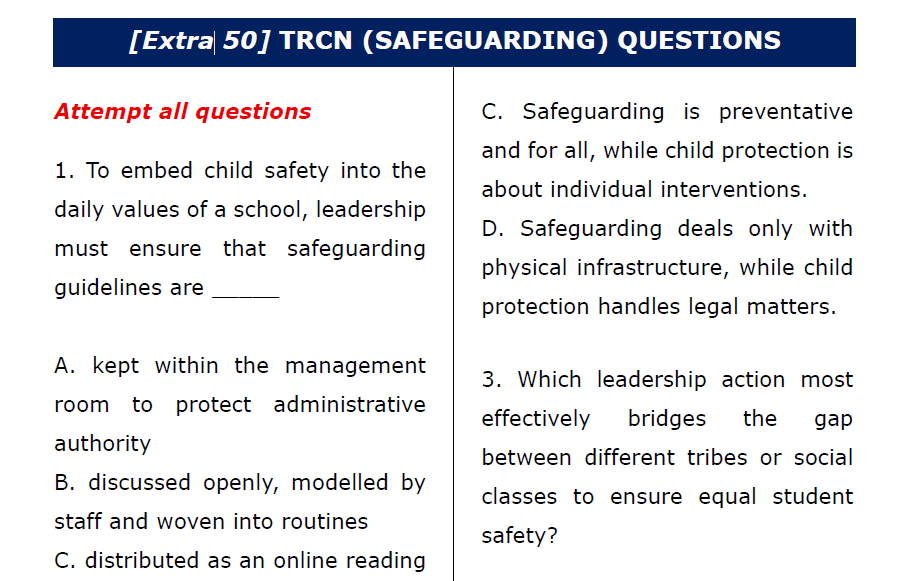
Download “tougher” TRCN questions on Safeguarding PDF
Get e-Notes and CBT
Did you fail many of the TRCN Safeguarding questions above?
Get Safeguarding e-Notes and practice more questions on all the (5) TRCN topics in CBT format?



Leave a Reply