
This connects abstract numerical concepts with the physical world.
You must know how to classify spatial figures, manage spatial dimensions, and convert units in the metric system—critical for subjects like Basic Science, Agric. and even Home Economics.
1. Classification of 2D and 3D Shapes
Learners must understand the structural properties that distinguish flat (two-dimensional) planes from solid (three-dimensional) objects.
2D shapes
2D shapes are flat planes bounded by lines of two dimensions (length and width).
They are classified by their number of sides, interior angles, and lines of symmetry.
- Triangles:
- Equilateral = 3 equal sides
- Isosceles = 2 equal sides
- Scalene = no equal sides
- Right-angled = one 90° angle
- Quadrilaterals:
- Square: 4 equal sides, 4 right angles, 4 lines of symmetry.
- Rectangle: Opposite sides equal, 4 right angles, 2 lines of symmetry.
- Parallelogram: Opposite sides parallel and equal, opposite angles equal, no lines of symmetry.
3D shapes
3D shapes are solid objects containing volume.
They’re defined by three elements:
- Faces: The flat or curved surfaces making up the exterior.
- Edges: The line segments where two faces meet.
- Vertices: The corner points where three or more edges intersect.
Euler’s Formula for Polyhedra
For any standard flat-faced 3D solid (cubes, prisms, or pyramids), the relationship between faces (F), vertices (V), and edges (E) always conforms to this mathematical law:
- F + V – E = 2
2. Conversion in the Metric System
The metric system is decimal-based, moving up or down by powers of 10.
Master how to navigate conversions across length, mass, and fluid capacity.
| Kilo- | 1,000 |
| Hecto- | 100 |
| Deca- | 10 |
| Base Unit (m, g, L) | 1 |
| Deci- | 0.1 |
| Centi- | 0.01 |
| Milli- | 0.001 |
Conversion constants
- Length:
- 1 km = 1,000 m
- 1 m = 100 cm
- 1 cm = 10 mm
- Mass:
- 1 kg = 1,000 g
- 1 g = 1,000 mg
- Capacity/Volume:
- 1 Litre (L) = 1,000 millilitres (mL)
- Spatial volume:
- 1 cm3 = 1 mL
- 1,000 cm3 = 1 L
Sample question: A school compound layout design requires an agricultural bed that is 3.4 metres long. What is this length in millimetres?
See workings:
- Identify the conversion from metres to millimetres:
- Since 1m = 100cm and 1cm = 10mm:
- 1m = 100 × 10 = 1,000 mm
- Multiply the given value by 1,000:
- 3.4 × 1,000 = 3,400 mm
Answer: 3,400 mm
3. Introduction to Coordinates
Coordinates allow you to pinpoint any position on a flat grid surface using an ordered pair written as (x, y).
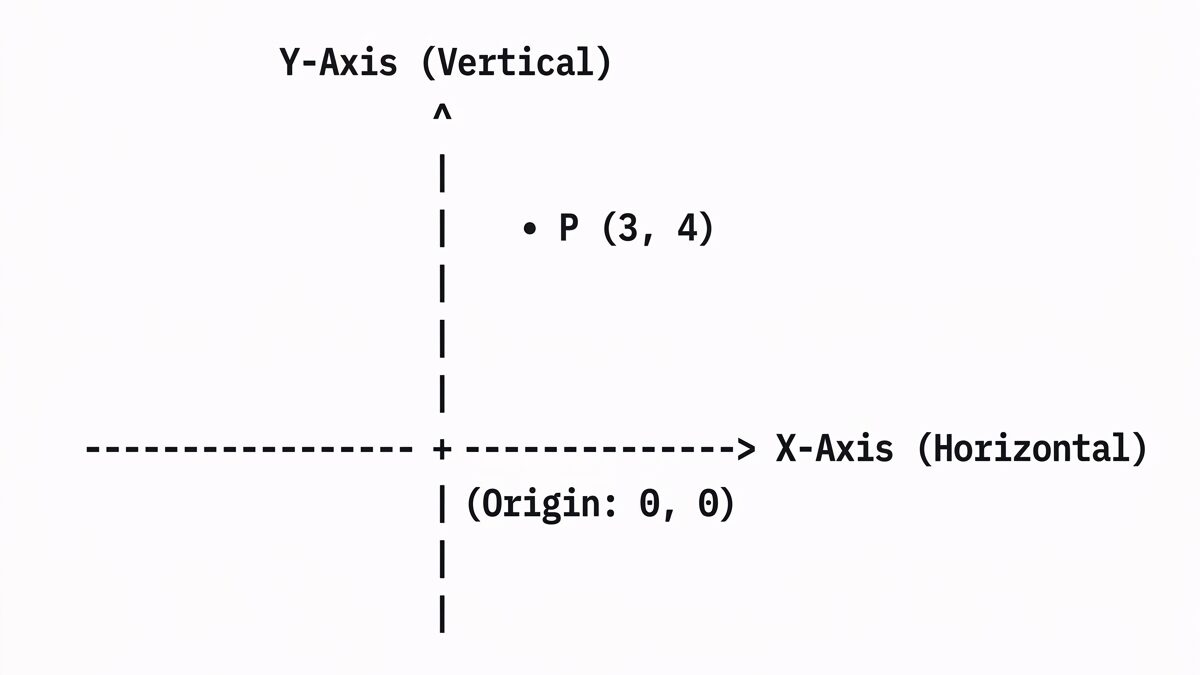
Cartesian plane
Formed by the intersection of a horizontal line (X-axis) and a vertical line (Y-axis).
Origin
The starting point where the two axes cross, represented by the coordinate (0, 0).
Grid Order rule
When plotting or reading a coordinate, do the horizontal distance (x) first, before the vertical distance (y).
Sample question: A student starts at the origin (0,0) on a grid map, moves 4 units to the right along the horizontal axis, and then moves 5 units down vertically. What are the coordinates of the student’s final position?
See workings:
- Horizontal axis (x): Moving right indicates positive change.
- x = 0 + 4 = (4)
- Vertical axis (y): Moving down indicates negative change.
- y = 0 – 5 = (-5)
- Combine into the standard format (x, y):
Final Coordinate = (4, -5)
Geometry Teaching Strategy
If an exam question asks: “A student states that a square is not a rectangle because a rectangle has two long sides and two short sides. How should the teacher correct this misconception?”
Wrong: Agree with the student and emphasize that squares have equal sides while rectangles do not.
Right: Explain that a rectangle is defined strictly as a quadrilateral with four 90° angles. Since a square has four 90° angles, it is a special type of rectangle where all four sides happen to be equal in length.


Leave a Reply