
Arithmetic is the bedrock of a student’s math life.
And If a learner leaves primary or junior secondary school with gaps in these core concepts, they’ll struggle with algebra, science and everyday life calculations.
As a certified educator, you must understand this basic math and how to make numbers make sense.
1. Place Value and Number Base Systems
Place value (Base 10)
This is the value of each digit based on its position in a number.
Many students confuse the value of a digit with the digit itself.
- Make your student understand that in 427.58 (for instance), the digit 2 represents 20 (two tens) and digit 5 represents 0.5 (five-tenths).
Number base systems
Humans use “base 10” (decimal), but computers use “base 2” (binary).
You must be able to convert between bases.
- Sample question: Convert 25 (base ten) to a binary number.
- See workings:
- To convert from Base 10 to another base, use successive division by that base, and count the remainders from bottom to top.
Answer: 2510 = 110012
2. Properties of Operations
Three properties are the structural rules of arithmetic.
They allow for the manipulation of numbers to make calculations easier.
Commutative property
The order doesn’t matter.
- Addition:
- a + b = b + a
- 5 + 3 = 3 + 5
- Multiplication:
- a × b = b × a
- 4 × 6 = 6 × 4
Warning: Subtraction and Division do NOT follow this rule. (5 – 3 ≠ 3 – 5).
Associative property
Grouping doesn’t matter.
- Addition:
- (a + b) + c = a + (b + c)
- (2 + 3) + 4 = 2 + (3 + 4)
- Multiplication:
- (a × b) × c = a × (b × c)
- (2 × 3) × 4 = 2 × (3 × 4)
Distributive property
Multiplication over Addition
Useful for mental math.
- Formula: a × (b + c) = (a × b) + (a × c)
- Compute: 7 × 12
- 7 × (10 + 2) = (7 × 10) + (7 × 2) = 70 + 14
3. Algorithms for Core Operations
An algorithm is a step-by-step procedure for solving a problem.
When a student calculates using multiple operations, they must follow the order of operations: BODMAS
- Brackets
- Of (power/root)
- Division
- Multiplication
- Addition
- Subtraction
Sample question: Simplify the following expression: 15 + 24 ÷ (8 – 2) × 3
See workings:
Following BODMAS rule:
- B (Brackets) first: 8 – 2 = 6
- 15 + 24 ÷ 6 × 3
- D (Division) next: 24 ÷ 6 = 4
- 15 + 4 × 3
- M (Multiplication) next: 4 × 3 = 12
- 15 + 12
- A (Addition) final step: 15 + 12
Answer: 27
4. Factors, Multiples, HCF, LCM, and Square Roots
HCF and LCM
HCF means the Highest Common Factor.
- Factors: Numbers that divide a particular number without remainder.
LCM means the Lowest Common Multiple.
- Multiples: Numbers gotten by multiplying a particular number by whole numbers.
Sample question: Find the HCF and LCM of 12 and 18.
See workings:
First, break both down into their prime factorizations:
- 12 = 2 × 2 × 3
- 18 = 2 × 3 × 3
To find HCF
Add the highest factors they each have in common.
- HCF → (3) + (3) = 6
To find LCM
Multiply all the factors they each have in common.
- LCM → (2 × 2) × (3 × 3)
- 4 × 9 = 36
Squares and square roots
A square root is the value that, when multiplied by itself, gives the original number.
Use prime factorization to find square roots without calculators.
- Prime factorize 144 → 2 × 2 × 2 × 2 × 3 × 3
- Group them into two identical sets:
- (2 × 2 × 3) × (2 × 2 × 3) = 12 × 12
- Therefore, √144 = 12
5. Fractions, Decimals and Percentages
Show that fractions, decimals, and percentages are just three different languages expressing the same value.
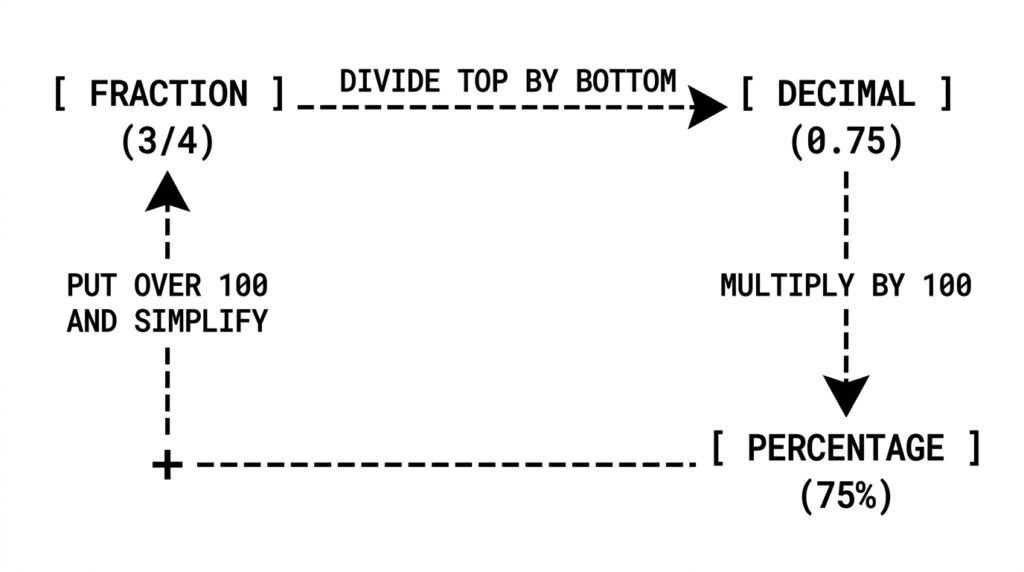
Sample question: Convert 3/5 to a decimal and a percentage.
See workings:
To Decimal:
Divide the numerator (3) by the denominator (5).
- 3 ÷ 5 = 0.6
To Percentage:
Multiply the decimal by 100.
- 0.6 × 100 = 60%
To Fraction:
Divide the percentage by 100 to its lowest term.
- 60/100 = 3/5
6. Rates, Ratios and Proportions
These concepts apply arithmetic to real-world problems like business profit, distributions and scaling.
Sharing by ratio
Sample question: A headteacher shares 45 textbooks between two classes, Class A and Class B, in the ratio 2:3. How many textbooks does Class B receive?
See workings:
- Find the total number of parts in the ratio.
- Total parts: 2 + 3 = 5 parts
- Identify Class B’s share of the ratio, which is 3 parts out of the total 5 parts.
- Class B’s Share = 3/5
- Multiply this fraction by the total quantity of books.
- Class B’s books = 3/5 × 45
Answer: Class B receives 27 textbooks.
Inverse proportion
Don’t use direct multiplication to problems that require inverse operations.
Sample question: If 6 labourers can clear a school farm in 4 hours, how long will it take 8 labourers to clear the same farm working at the same rate?
WARNING: More workers mean less time. This is an inverse proportion, not direct.
See workings:
- Calculate total workload in “man-hours”
- = 6 labourers × 4 hours = 24 man-hours
- Divide total workload by the new number of labourers (8) to get the new hours
- = 24 man-hours / 8 labourers
Answer: 3 hours
Numeracy Teaching Strategy
If an exam question asks: “A student constantly solves 18 – 5 + 2 by adding 5 + 2 = 7 first to get 18 – 7 = 11. How should the teacher correct this misconception?”
Wrong: Tell the student that BODMAS means addition must always come before subtraction.
Right: Explain that Addition and Subtraction carry equal priority and must be solved from left to right. The negative sign belongs to 5 (meaning -5 + 2 = -3), so the correct working is 18 – 5 = 13, then 13 + 2 = 15.


Leave a Reply